Either way, anger is a powerful catalyst but a life-sucking companion.
Brené Brown, Braving the wilderness
I. Black Forest Croissants
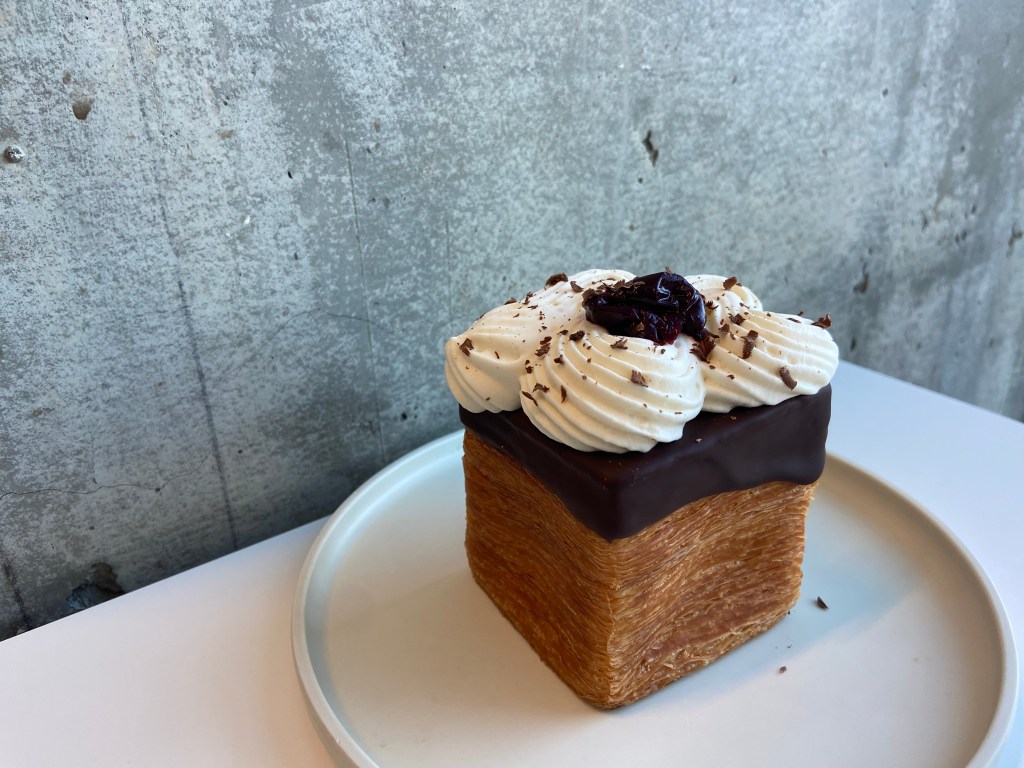
Black Forest cube croissants.
That was the singular thought in my head, framed in a sparkling sense of purpose, as I woke to my morning alarm’s piercing blare.
I had been coveting one of these bad boys since I saw them displayed behind the countertop glass at my favourite plant-based bakery. Next to the plain Jane croissants, they had looked downright sinful; the dripping dark chocolate ganache, clouds of coconut whipped cream, and plump maraschino cherries promised a rich tasting experience that would justify the sugar headache that would doubtlessly follow.
Excitement lifted my body out of bed, and I prepared to venture out on my breakfast mission.
*
Thirty minutes later, I was making a beeline for the bakery’s familiar entrance. I noticed an older couple heading in the same direction, albeit from the opposite way. The woman had a strange, uneven gait; upon closer inspection, I realized her left foot was encased in a medical walking boot.
The bakery is known to attract heavy foot traffic at certain hours of the day. Disabled elderly couple or not, my inner cavewoman balked at the prospect of a queue when my prize was so close within reach.
I shouldn’t have worried though. Despite their slower pace, the couple reached the entrance first and disappeared through the threshold, the husband holding the door for his hobbling wife. When I rounded the corner, I was surprised to see he was still holding it open, despite the fact that I was a solid several seconds behind. His slightly stern gaze met mine, and he offered me a polite nod. I was not too lost in single-minded pursuit to neglect to appreciate this simple gesture. Thanking him, I ducked inside.
The warming scent of coffee and (vegan) butter enveloped me immediately. A thrill ran through me when I realized that, apart from the husband-and-wife duo, the space before the counter was blissfully empty.
The woman twisted around and addressed me with an open expression. “Oh, you can go ahead before us. We’re going to get a handful of things,” she said. Up close I could see that her hair under her woolly hat was shorn close to her skull.
Blinking away this seemingly extraneous detail, I thanked the woman and, with the path to my prize now clear, stepped up to order. A Black Forest croissant was a solid, beckoning weight in my hands not a minute later. Excitement made my heartbeat thrum in my chest.
The bakery’s noisy volume and tight space usually drive me to take my baked goods to go, but today was a special day: I was finally about to sink my teeth into this confection of sweet-cherry and chocolatey goodness. Like a squirrel with her nut, I opted to enjoy my bounty right then and there. I sat down at a small corner table facing the window.
I was heartily in the middle of attempting to bite into the cube without covering my nose in whipped cream (it was all in vain, as croissant crumbs were flaking off in a cloud around my hair) when I registered the older woman from before gingerly take the opposite seat at the table next to mine. I noticed her notice me.
“That croissant’s almost as big as you are!” she remarked, chuckling. The bakery’s warmth had created pinpricks of condensation that fogged up her glasses, but behind them her pale eyes were clear with a soft brightness.
There are times, mainly when I’m eating, when forcing small talk with strangers sets my nerves on edge. But there was something so light and good-natured about this woman’s energy that a burst of laughter escaped around my mouthful of whipped cream and chocolate.
“I did wonder if this was a good idea to eat first thing in the morning, but I wanted to try it at least once. It looked so good,” I answered from behind a napkin. I did my best to politely wipe my mouth clean. Still, I had a feeling a pastry garnished as decadently as this one would leave traces.
“Everything’s worth trying at least once,” she said, laughter still colouring her voice.
(I realized later that there was indeed an errant swipe of chocolate on my chin.)
We smiled at each other and exchanged a few more pleasantries, then her husband arrived with their coffee and sandwiches. I went back to work on my croissant. Although it tasted as sumptuous as I imagined, the rich cream and surprisingly liberal filling of chocolate mousse made it all-together too heavy for my first meal of the day. It sat like a disappointing stone in my stomach.
One thing you should know about me, Reader, is that as a person with both autism and ADHD, my emotional balance can be tipped by the smallest shift in scales. Sensory overwhelm is something I battle every day, so sometimes a dip in mood is all it takes to cause my mental shields, which safeguard me against the external chaos of the world, to come crashing down. Already I could feel the chatter, loud-speaker music, and warmth of the bakery pressing in.
However, much to my surprise, I noticed a second, lighter feeling—distinct from my mounting irritation—unfurling from behind my navel. Next to the disappointment in my belly, it felt like a balloon trying to lift a pebble.
Strange, I thought absently, to hold two polarizing emotions at once.
I ruefully polished off the rest of my pastry then dusted the scattered crumbs onto my plate. As I got up to leave, silently promising myself I’d have something light for lunch, the woman broke away from her conversation with her husband. She leaned over, met my eyes, and said warmly, “You have a great day now.”
I was momentarily struck by the sincerity I felt in her words, but thankfully my manners kicked in. I gave her one last smile and returned her regards to her and her husband. In spite of the heavy fullness in my stomach, I left the now-bustling bakery light as a balloon.
II. Interlude
What is it about kindness that draws out our better selves? I wondered as I embarked on a brisk walk. I’d hoped some exercise would help disperse the sugar-laden food baby I was now carrying. And what is it about experiencing kindness in real life that makes any gratification of the digital world pale with disparaging contrast?
Is it because we so seldom expect kindness from strangers nowadays, in this politically heightened and divided world, that our connection-starved souls feel the impact of any human gesture with more force than we otherwise would?
Or has the power of kindness always been there, and it took being separated from each other by illusory walls for us to truly appreciate it?
Many of us experience the majority of our lives online nowadays. Here, everything is polarized. Whether that’s the result of the projection of our own internal anxieties, the machinations of the Powers That Be, or some grotesque combination of both remains to be seen. But a polarized landscape means that everything we see and interact with innately carries the tinder-like potential for conflict.
And anyone who’s ever spent time in the comments section of the Internet knows: conflict can make you incredibly angry.
Anger is a strange thing. I hesitate to call it an emotion, because although people tend to classify it as such, “emotion” doesn’t feel to me like an accurate container. All I know is that anger can be defined in many ways, shaped by contexts both internal and external.
For example, anger as a temporary reaction can be a useful indicator of something deeper: a boundary crossed, or perhaps even a value desecrated. It can reveal a deeper truth about what’s important to you and galvanize you to fight to protect those things.
But left to fester, anger can morph into something darker. Oppressive. Harmful. Yet wholly intoxicating in its righteousness.
Instead of spurring you on to fight to protect out of love, anger becomes a weapon wielded to wound and bring down. It convinces you that anything you do or say in its name, regardless of whether it causes harm, is simply a means to some virtuous end.
It’s for this reason that I believe certain people mistake sustained anger for passion.
The distinction between the two, if you’re curious, Reader, is that unlike passion, anger is a prison. It may offer a burning sense of purpose that feels like passion. But that burning is self-destructive.
For unlike passion, anger does not brave the limitations of the ego for the wider world. It does not challenge the conviction that, for all my raging on behalf of a righteous cause, I am the centre of the story. I must come out on top, or the world will burn.
I will let the world burn if I don’t get what I want.
That is why, outwardly, this kind of anger often appears destructive. Explosive. Frightening, in the way it sucks all the air out of any given space. Yet still oddly childish.
For all its peacockish signaling of power, anger is one of those energies that does not wear well on a person. Because who wants to hang around someone who’s constantly angry?
I mean that rhetorically, but the answer is: other angry people.
All this to say: regardless of how you experience anger—inwardly or outwardly, on the Internet or in real life—you can’t deny that it is a block to true connection. Connections with other people aside, conflict, ego, the holding onto of anger; these are things that keep us from connecting with the parts of life we actually enjoy. (Like delicious pastries.)
And without enjoying life—without tapping into that inner sanctuary where joy and contentment and connection reside—we cannot hope to begin to create a life worth living.
III. A Dog Named Noodle
Lost as I was in these thoughts, I almost didn’t notice the sweet, curly haired dog standing with his owner off to the side of the pavement. The dog was staring at me, but his owner had his head bent over his phone.
Now, I’m a fan of greeting every four-legged friend I encounter (even if it’s just with my eyes from a respectable distance), but not every dog or owner welcomes advances from a well-meaning but random stranger. Lucky for me this particular pup seemed happy to engage.
He padded over once I was in close enough proximity and nosed a hello against the side of my jeans.
“Noodle, you want to say good morning?” his owner said, looking up from his phone. His easy tone that implied this was not out of the ordinary for Mr. Noodle.
“His name is Noodle?” I asked with no small delight.
He laughed. “Yes, we named him Noodle because when he misses someone, he does this funny noodling motion with his head. And when he was small, he looked like a pile of ramen noodles.”
One ear on this adorable story, my main attention was on Noodle, who, in between sniffing at my hands, was peering up at me with beseeching brown eyes. If I’m honest, he looked like he could start a very successful petfluencer page. Standing at hip-height with a dense coat of curling fur (black on the body, white on the stomach), Noodle had a gentle way about him that millions of social media users would without a doubt love. Maybe he already had one; perhaps his owner was in the middle of posting to it before our paths crossed.
I bent down so I could properly smile at Noodle and give him the good morning he was asking for. Reaching out a hand to stroke his soft-looking fur, the realization flashed into my mind then, the moment I looked into his benevolent, inhuman eyes.
What is it about kindness that draws out our better selves? And what is it about experiencing kindness in real life that makes any gratification of the digital world pale with disparaging contrast?
It is a portal—an always-available invitation—to connect deeper into what a mysterious and sometimes unexpected joy life is.
For what I felt shining out from Noodle’s happy gaze and in my earlier interaction with the woman at the bakery, no level of AI sophistication, rage-baiting, or algorithm “intelligence” could ever hope to replicate.
Afterword
There’s no doubt in my mind that my sunny mood would have dampened that morning had I not crossed paths with that elderly couple or Noodle the dog. I had been looking forward to that Black Forest croissant for weeks. Knowing myself, I’m certain that the sense of galvanizing energy that had propelled me out of bed would have followed the natural trajectory of an expectation fallen flat.
And it did, for a moment. I didn’t get what I thought I wanted. But thanks to the constellation of small yet positive connections I made that day, it didn’t really matter.
 The Canary Poet